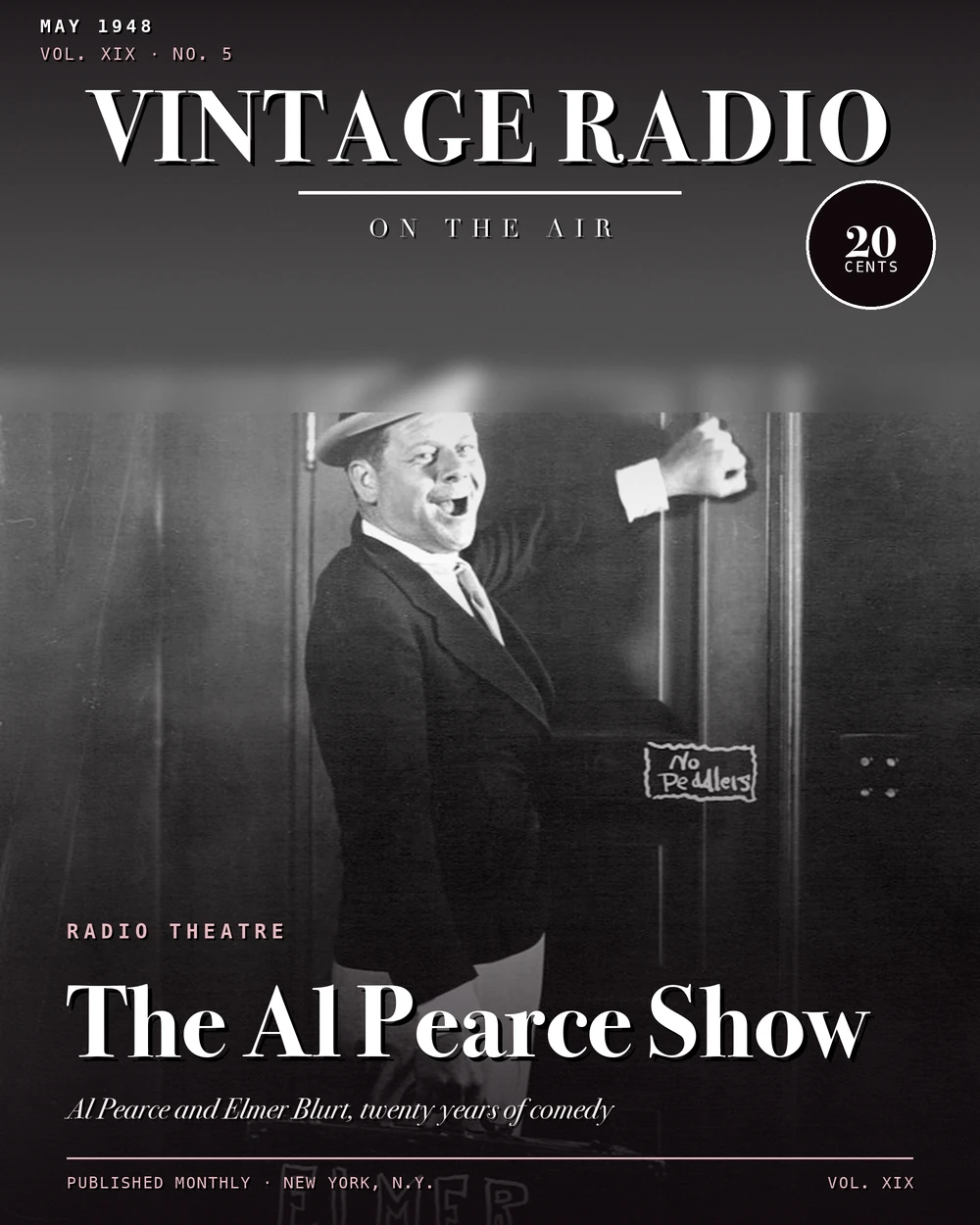
The Al Pearce Show
The Man Behind the Knock
Al Pearce didn't set out to be a radio comedian. Born Albert Walter Pearce on July 25, 1898, in San Jose, California, he spent his early working years selling insurance door-to-door and, with his brother Cal, performing in a real estate glee club on the side. A KFRC executive spotted the two brothers doing a vaudeville sketch at a real estate convention and hired them on the spot. By 1928, Al Pearce was at the San Francisco station, singing and playing banjo on what would become The Happy-Go-Lucky Hour — a musical-variety program that built a real following across the Bay Area and eventually reached as far as Canada.
The pivot from genial variety performer to recognizable comic character came when a writer named Jack Hasty handed Pearce a sketch about a timid door-to-door salesman. The fit was obvious to everyone, Pearce included: the man had actually sold insurance door-to-door. Hasty's original character was called Elmer Blurp, but the name was quickly smoothed to Elmer Blurt, and the character took on a life that would outlast every network contract, every sponsor change, and most of Pearce's contemporaries. Elmer was bashful to the point of dysfunction — a man who would rather lose a sale than face a customer. His signature was a distinctive knock: bump-bump-abump-bump . . . bump-bump. Then, into the silence that followed, came the muttered hope: "Nobody home, I-hope-I-hope-I-hope." That catchphrase became a national slogan.
The Gang
A show called Al Pearce and His Gang needs a gang worth mentioning, and across nearly two decades Pearce assembled an unusually large ensemble of recurring performers. In the early KFRC years, the lineup included his brother Cal, along with Harry K. McClintock, Jean Clarimoux, Norman Nielsen, Hazel Warner, Abe Bloom, Monroe Upton as Lord Bilgewater, and several others. By the mid-1930s, the roster had grown and sharpened considerably.
Arlene Harris, billed as "the human chatterbox," was one of the gang's most distinctive voices — capable of delivering rapid-fire telephone monologues to her friend Mazie at 240 words per minute. Bill Comstock played Tizzie Lish, a female character he had originally developed on a recipe show at another station, who served as the program's cooking and health expert. Jennison Parker and Bill Wright worked as the comedy team Yah-but and Cheerily, while Pearce himself played Eb opposite Wright's Zeb in sketches about two elderly men running a crossroads general store. Kitty O'Neil, known as "the laughing lady," rounded out the comic side of the ensemble.
Harry Stewart, who joined in the fall of 1932, developed the character of Yogi Yorgesson — originally conceived as a Hindu mystic from Stockholm before evolving into something more grounded. Stewart deliberately built Yorgesson to be smarter than the naive-rube Scandinavian dialect comedian type, basing the character partly on a Swedish restaurant owner he knew in Seattle and partly on Mahatma Gandhi. Yogi's nonsense songs, including Yingle Bells and I Yust Go Nuts at Christmas, became audience favorites on the show. Years later, after Stewart had left the program, the Yorgesson persona would generate a gold-record single on Capitol Records — the "I Yust Go Nuts at Christmas" / "Yingle Bells" coupling, backed by the Johnny Duffy Trio, sold over a million copies in 1949. Stewart's prediction routine on the Pearce show has also been cited as a possible influence on Johnny Carson's later "Karnac" character.
Morey Amsterdam was another mid-1930s gang regular, appearing on the show before going on to national fame decades later as Buddy Sorrell on CBS's The Dick Van Dyke Show (1961–1966). Amsterdam married fellow gang member Mabel Todd in 1933; the two divorced in 1945. Artie Auerbach joined in 1937, bringing the Yiddish-accented character Mr. Kitzel, whose catchphrase was "Hmmm... could be!" Auerbach's backstory was unusual — before radio, he had been a newspaper photographer and reporter who covered the Hall-Mills murder case and the Lindbergh kidnapping for publications including The New York Graphic and the New York Daily Mirror. After roughly two seasons with Pearce, Auerbach toured hundreds of Army posts and Navy boot camps, then brought Mr. Kitzel to The Abbott & Costello Program in October 1944, and eventually to The Jack Benny Program in January 1946, where the character stayed for about twelve years.
The announcers — Bill Goodwin, Ken Roberts, and Wendell Niles — and orchestra leaders Harry Sosnik, Larry Marsh, and Carl Hoff kept the show moving, while sound effects man Ray Erlenbom handled the sonic details. Many gang members stayed with Pearce through the show's frequent changes of format, network, and sponsor, which is itself some testimony to how the ensemble functioned.
A Show That Never Stayed Still
Few radio comedy programs moved around the dial as often as The Al Pearce Show. After the local KFRC run ended in 1932, Pearce came to national radio on the Blue Network in January 1934. From there, the show cycled through NBC, CBS, back to NBC, back to CBS, briefly to the Blue Network again, then to ABC — picking up and dropping sponsors along the way: Pepsodent, Ford Motors, Grape Nuts, Dole Pineapple, Camel Cigarettes, Dr. Pepper, and Lewis-Howe. At various points the program broadcast under alternate titles including Watch the Fun Go By, Fun Valley, and Here Comes Elmer, with the Elmer Blurt character sometimes prominent enough to carry the billing entirely.
The 1944 Blue Network run as Fun Valley, sponsored by Dr. Pepper, lasted only May through July — and ended when the sponsor replaced the show with an audience-participation program called Darts for Dough and stayed with the new format. Pearce moved on. The CBS run in late 1944 and into 1945 was sponsored by Lewis-Howe, with the Elmer character prominent enough that the program sometimes went out as Here Comes Elmer. By December 1945, the show had shifted to ABC for a five-day-a-week daytime strip, and the final broadcast came on October 25, 1947 — a 60-minute Saturday morning program, the last of a run that had started nearly two decades earlier on a San Francisco radio station.
The Film Work
The show's national profile in the 1930s was strong enough to bring Pearce to Hollywood. He made his film debut in The Hit Parade (1937) for Republic Pictures. In 1943, Republic released Here Comes Elmer, directed by Joseph Santley and running 74 minutes, with Pearce playing both himself and Elmer Blurt. The plot turned on Pearce's radio troupe getting fired after a sponsor's parrot repeats derogatory remarks on the air — a comic premise with some real-world resonance for anyone in the business. The cast included Gang regulars Arlene Harris, Artie Auerbach (as Mr. Kitzel), and Bill Comstock as Tizzie Lish, along with Dale Evans, Gloria Stuart, and, in a cameo that modern reviewers have singled out, the Nat King Cole Trio appearing as train conductors and performing "Straighten Up and Fly Right." Wendell Niles, Pinky Tomlin, and Jan Garber and His Band also appeared. Pearce followed with Hitchhike to Happiness (1945, again with Dale Evans), One Exciting Week (1946), and The Main Street Kid (1948, in which he played a character named Otis Jones), all Republic productions.
During the war years, Pearce also appeared frequently on Armed Forces Radio Service programs, including Mail Call and Command Performance.
After the Radio Run
Pearce's radio popularity faded quickly after World War II, and his comedy was seen as belonging to an earlier style. He made an attempt at television in 1952, with two separate CBS series. The morning show, originating in Hollywood and directed at housewives, ran from February 11 to September 26, 1952, initially at 45 minutes starting at 7:45 a.m. Pacific Time on KNXT — reportedly the earliest network television program broadcast live from Hollywood. An evening version alternated with The George Burns and Gracie Allen Show on CBS Thursday nights from July 10 to September 18, 1952, when Burns and Allen went weekly and the Pearce show ended. Both runs featured Gang veterans Arlene Harris, Bill Comstock as Tizzie Lish, Harry Stewart's Yogi Yorgesson, and singer Art Morton, but neither version found an audience, and Pearce — who had come out of retirement for the television effort — reportedly disliked the schedule. He did not pursue it further.
In the late 1950s he worked as a spokesman for Rambler American automobiles. On February 8, 1960, he received a star on the Hollywood Walk of Fame for his radio work, located near 6328 Hollywood Boulevard. He died on June 2, 1961, in Newport Beach, California, of heart disease.
The record of the show that survives includes script files, transcription disks, photographs, and personal memorabilia held in the Al Pearce Papers at UCLA Library Special Collections, covering the period from the late 1930s through the mid-1940s. The scripts document not only The Al Pearce Show and Al Pearce and His Gang but also Fun Valley, Here Comes Elmer, The Life of Elmer Blurt, and Backstage in Broadcasting. The collection even includes an Al Pearce and His Happy Prune Pickers recipe booklet — a piece of promotional merchandise that probably tells you something about the breadth of the show's brand at its peak. The Elmer Blurt character, with his hopeful knock and his muttered wish for an empty house, was the engine that drove all of it.